The AI New Agency Model Has Dismantled 100 Years of Agency Thinking.


For most of the past century, advertising agencies were built around the economics of human labor. Research took weeks, creative development required large departments, production involved multiple specialists, and work passed through layers of account management before eventually reaching the client—or occasionally disappearing into a meeting from which it was never seen again.
The people were often talented. The work could be extraordinary. The lunches occasionally became historic.
But the operating model remained remarkably consistent: gather a large number of people inside an impressive building, divide them into departments, record how many hours they worked, add a suitable margin and present the result to the client as modern marketing.
The AI agency model is now fundamentally different. The AI new agency model replaces large departments, junior-heavy staffing and billable-hour economics with smaller teams of experienced people whose judgment and creativity are amplified by artificial intelligence.
Artificial intelligence has just dismantled the old Agency model.

Why the AI new agency model changes everything.
First, it has compressed the work.
Research that once took days can be completed in hours. Agencies can analyze competitors, explore markets, develop strategic hypotheses, generate creative directions, visualize concepts, produce content and create campaign variations much faster than before.
Second, it has expanded what small, experienced teams can accomplish.
A strategically strong consultancy no longer needs a large conventional agency structure to deliver sophisticated research, strategy, design, content and marketing execution. AI gives senior people enormous leverage.
Third, it has changed what clients should pay agencies for.
Clients will become increasingly reluctant to pay substantial fees for routine production, large junior teams or hours spent assembling information they can now generate themselves. They will pay for better thinking: identifying the real problem, seeing opportunities others miss, making difficult choices, creating meaningful differentiation and turning all of that into effective work.

In the future, AI will move from being a tool people use, to becoming part of the agency’s operating system.
AI agents will continuously monitor markets, competitors, customers and campaign performance; recommend actions; generate and test variations; personalize experiences; and automate large parts of production and reporting.
But this will create a paradox. As everyone gains access to similar technology, producing competent work becomes easier—and producing distinctive work becomes harder.
AI has not eliminated the need for marketing agencies, brand consultancies or creative expertise. It has dismantled the century-old assumptions about how these organizations need to be structured, staffed, priced and operated—and what clients should reasonably expect to receive for their investment.
“AI has not dismantled creativity. It has dismantled the expensive machinery that used to surround it.”
The traditional advertising agency was built for a slower world
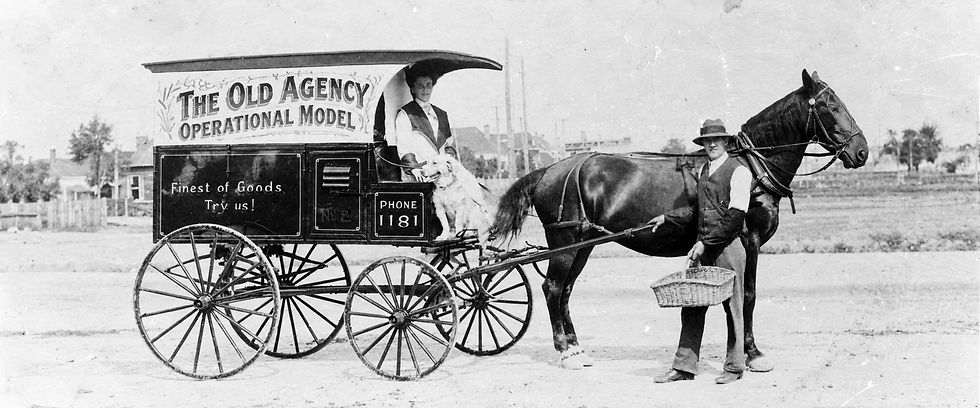
Traditional advertising agencies became large because the work required large numbers of people. Information was difficult to find, market research was expensive, competitive analysis was labor-intensive, presentations took days to assemble, and producing advertisements, films, websites and campaign variations required layers of specialized talent and coordination.
Scale was not simply vanity, although Madison Avenue developed an admirable ability to make overhead look glamorous. Scale was necessary to get the work done.
Account people spoke to clients, researchers researched, strategists strategized, creative teams disappeared behind closed doors, production departments produced, media departments bought media, and junior employees performed much of the time-consuming work supporting the senior executives whose names and biographies featured prominently in the pitch.
Work moved through the agency rather like a suitcase passing through Heathrow: handled by many people, temporarily misplaced and eventually arriving more expensive than expected.
That equation no longer makes sense.
AI has compressed the work
“AI-powered marketing tools can now help experienced teams analyze competitors, explore markets, synthesize customer opinions, identify behavioral patterns, develop strategic hypotheses, generate creative directions, visualize concepts, produce content and create multiple campaign variations in a fraction of the time previously required.”

Research that once took days or weeks can be completed in hours. Strategic possibilities can be investigated while they are still relevant, and creative territories that might previously have required several teams and rounds of internal development can be explored before lunch.
This does not mean every assignment should be completed at the speed of a drive-through order. Some thinking requires argument, reflection, experience and the occasional long walk in which nobody checks a device.
“AI has made execution dramatically cheaper. It hasn’t made judgment any cheaper. If anything, good judgment just became more valuable.”
The greater advantage is not simply speed. AI allows strategists to examine more competitors, customer conversations, market signals, cultural developments and alternative hypotheses than a conventional project budget would normally support. It expands the territory an experienced team can explore and improves the possibility of discovering an insight others have missed.
“AI reduces the cost of producing answers. It increases the value of asking the right questions.”
Small, senior teams can now do very big things
AI has given experienced people extraordinary leverage.

“A small team of senior strategists, brand thinkers, creative leaders and marketing specialists can now accomplish work that previously required a conventional agency pyramid.”
This is a radical departure from the traditional agency structure, in which a small number of senior leaders sat above a broad base of junior employees. Clients met the senior people during the pitch and gradually discovered that much of their business was being handled by people who had not been in the room—and sometimes not yet born—when the organization’s most important strategic decisions were made.
“An AI-native consultancy can invert that pyramid. Senior people remain close to the business problem, close to the client and close to the work, while AI performs much of the searching, sorting, summarizing, formatting, adapting and initial production that once consumed thousands of junior hours.”
This does not make human talent less important.
It allows talented people to spend more time applying it.
Clients should pay for value—not organizational weight

“AI has also changed what clients should reasonably expect to pay marketing agencies and brand consultancies for.”
Clients will become increasingly reluctant to fund large junior teams, routine production and hours spent gathering information they can now generate themselves. Nor should they pay for the privilege of moving their work between departments that rarely communicate without scheduling another meeting.
“Clients should pay for better thinking: identifying the real problem rather than obediently answering the original brief; seeing opportunities competitors have missed; making difficult choices; creating meaningful differentiation; and translating strategic intelligence into work that changes perception, behavior and commercial performance.”
When AI helps an experienced consultancy complete an assignment in three weeks instead of three months, the value of that work has not necessarily fallen. If the insight is deeper, the strategy sharper, collaboration closer, implementation faster and commercial result stronger, its value has increased.
Time spent is a poor substitute for value created.

The consultancies that succeed will increasingly sell judgment, outcomes and capability rather than bodies, hours and activity. Their advantage will not come from having the largest workforce, the most elaborate proprietary process or the greatest number of people invited to a status call. It will come from connecting business strategy, customer understanding, brand positioning, creativity and execution around one commercial objective.
AI will become the agency operating system
Most organizations currently use AI as a collection of tools. Someone asks a question, analyzes information, generates an image, summarizes a document, produces a first draft or adapts content for another audience.
The next stage will be considerably more significant.
“AI agents will continuously monitor markets, competitors, customers, cultural shifts, search behavior and campaign performance. They will identify changes, recommend actions, generate and test alternatives, personalize customer experiences, automate reporting and feed what they learn back into the next round of strategic and creative decisions.”
“Marketing will gradually move away from a sequence of disconnected campaigns and toward a continuous system of observation, interpretation, creation, testing and adaptation.”
That sounds wonderfully efficient because it will be.
It also sounds slightly terrifying because it could produce enough content to wallpaper the moon.
The great AI marketing paradox
“As every business and agency gains access to similar AI capabilities, producing competent marketing will become easier, faster and less expensive. Producing distinctive marketing that gives results - will become harder.”

Markets will be flooded with polished articles, attractive images, plausible strategies, adequate advertisements and videos featuring suspiciously perfect people walking purposefully through suspiciously clean offices.
The work will be technically impressive, strategically acceptable—and increasingly difficult to remember.
AI learns from what already exists. Strong brands create value by becoming meaningfully different from what already exists. This is why the future belongs neither to traditional advertising agencies resisting AI nor to automated content factories using it to manufacture infinite quantities of beige.
“The best marketing and brand consultancies will combine two forms of intelligence:
Artificial intelligence for speed, scale, research, analysis, iteration, personalization and execution.
Human intelligence for curiosity, judgment, empathy, imagination, taste, originality and meaning.”
“AI can reveal patterns, but people must decide which patterns matter. It can produce alternatives, but people must make choices. It can imitate almost any established style, but it cannot independently determine what a company should believe, what risk it should take or what its brand should mean in people’s lives.”
“AI can execute. It can’t decide what your brand should mean.”

RareMatter is built for the post-agency era, a new kind of strategy-led growth and creative consultancy.
RareMatter was created for this new environment—not as a smaller version of a traditional advertising agency, but as a new kind of strategy-led growth and creative consultancy.
We combine senior business, brand, marketing and creative experience with AI-enabled research, analysis, exploration, prototyping and execution. This allows us to investigate more possibilities, uncover deeper insights, work more collaboratively with client leadership and direct a greater percentage of every investment toward the thinking and creative work that produce value.
We begin with the business advantage, identify the growth opportunity, develop the strategy and positioning, build the brand story, and carry that thinking through creative development and market execution.
There are fewer layers, fewer handoffs and considerably less ceremonial busyness.
No mystery. No black box. No cast of thousands.
“The result is a faster, deeper, more collaborative and radically more cost-effective consultancy model—one that uses artificial intelligence to expand what a highly experienced team can accomplish while preserving the human intelligence required to determine what is worth accomplishing in the first place.”
Because the future of marketing will not be won by the agency capable of generating the most work.
It will be won by the consultancy that knows which work will matter.
Comments